
Our Programs
WEJ combines research, public education, and policy guidance to address the gender gap in climate and environmental policy.
research partnership program
community knowledge → funded research → published data → policy influence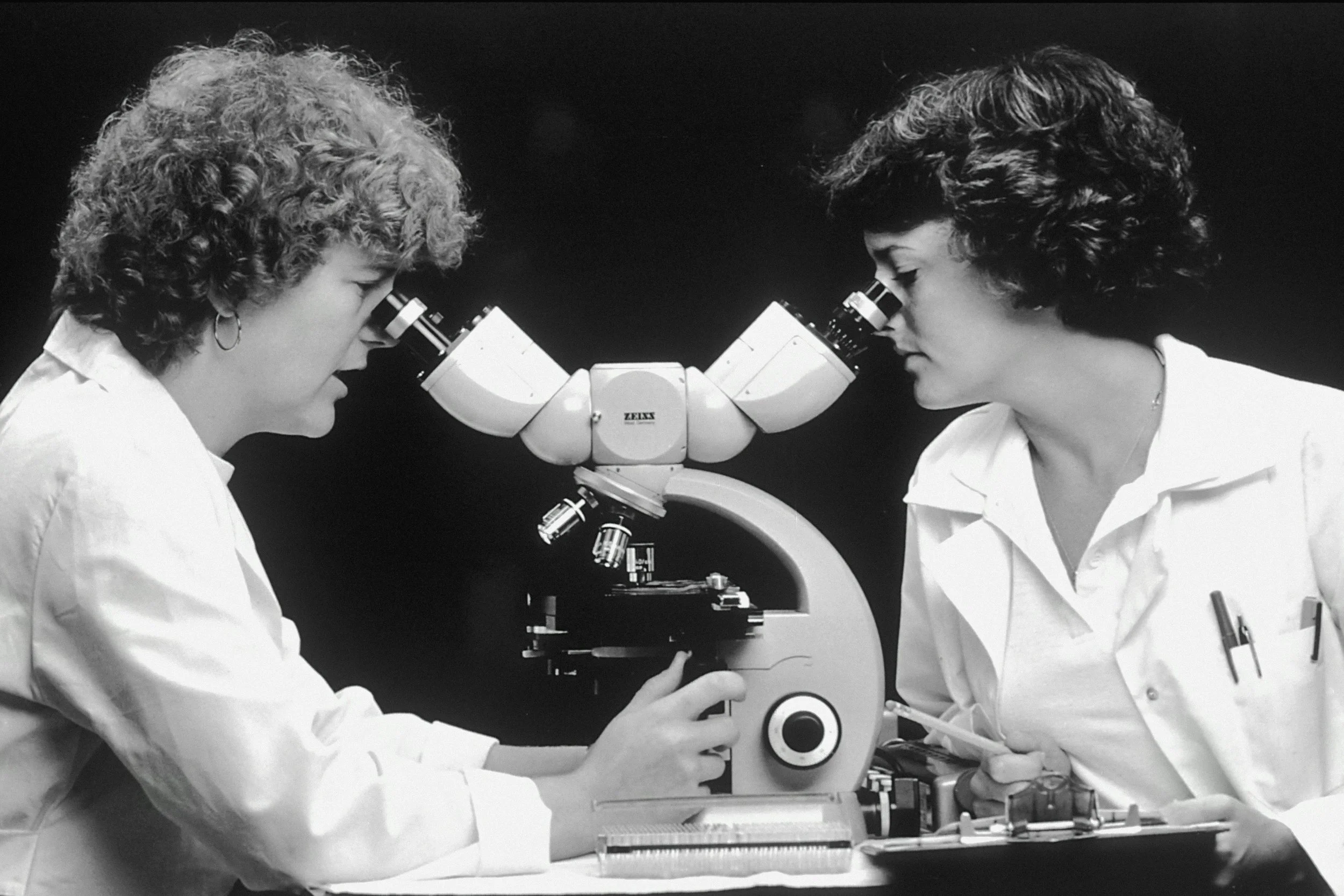
WEJ supports communities by offering a direct platform to publish research. Rather than operating as a traditional think tank that dictates research priorities, WEJ responds directly to community-identified needs. We help bridge research gaps and translate lived experiences into actionable, data-driven reports for key decision-makers.
Research and academia have significant institutional barriers that inhibit women, people of color, and low-income individuals from publishing research.
This not only limits an individual’s professional experience but also prohibits them from turning lived experiences into published data that decision-makers can use.
-
Practically, individuals, organizations, or communities can reach out to WEJ through our partnership program with a data need.
Together, we design a research study, combining the grassroots knowledge of the community member and the research experience of WEJ staff. This study is agreed to by both parties and must fit within WEJ’s mission to create gender-specific and/or gender-disaggregated research on environmental issues.
Once the proposed research methods are finalized, a project proposal will be drafted. This document will be used for public fundraising (Givebutter) and circulated to funders to provide the necessary financing to complete the project, including research software, staff hours, and other relevant expenses for the project.
Once funding is secured, the project team will develop a timeline and will commence the study.
At the end of the study, WEJ, in conjunction with the proposing organization, will publish the findings in a research report, along with any other written materials agreed upon in the original study proposal.
Research provides power.
WEJ is stepping in to help close the research and policy gap by providing a vehicle for communities to get the research they need and fund, structure, and execute their ideas.
Documenting communities’ experiences into published data will give advocates the tools they need to demand change from their decision-makers, which is what WEJ is here to do — demand environmental justice for all.
Partnership types
WEJ partners with mission‑aligned organizations, universities, and individuals to advance research, policy, and public education at the intersection of women’s rights and climate justice in the United States.
Partnerships help WEJ close critical research and policy gaps while creating tangible benefits for collaborators, including visibility, research capacity, and real‑world impact.
The program currently offers three partnership pathways: Organizational Partner, Educational Partner, and Individual Partner. Each pathway is designed to be flexible so that projects can be tailored to the partner’s goals, timelines, and audiences.
Organizational Partner
-
Non‑profit organizations, advocacy groups, foundations, and other mission‑aligned entities that want research capacity and policy‑relevant insights.
-
The partner identifies a research need (for example: documenting gendered climate impacts in a region).
WEJ works with the partner to scope and design a research project that responds to that need, including defining key questions, methods, timelines, and deliverables.
WEJ and the partner create a project team with regular check-ins and clear responsibilities. The structure of the relationship varies based on the specific organization and needs.
-
Research design and methodology planning tailored to the partner’s goals.
Data collection and analysis (e.g., policy reviews, literature reviews, qualitative or quantitative analysis) within WEJ’s mission scope.
Co‑branded outputs such as reports, briefs, presentations, or public webinars highlighting key findings and implications.
-
A clearly defined research question or need, plus relevant context and background.
If available, additional support from partner organization staff to increase research capacity and expedite timelines.
Collaboration on outreach, including featuring WEJ in newsletters, websites, and social media; co‑hosting webinars or events; and including WEJ in relevant funding proposals and opportunities.
Where appropriate, access to relevant datasets, networks, or subject‑matter experts to strengthen the project.
Educational Partner
-
Post‑secondary institutions, including universities and HBCUs, especially those with graduate‑level courses, capstones, or research requirements aligned with climate, environment, gender, public policy, or related fields.
-
Educational partners create pathways for their students to collaborate with WEJ as part of a course, capstone, practicum, thesis, or independent study.
Faculty or program administrators coordinate with WEJ to identify suitable projects that align with learning objectives and WEJ’s research agenda.
Students work on pre‑designed WEJ projects or self‑designed projects (with approval), under joint oversight from WEJ and their institution.
-
A menu of project topics aligned with WEJ’s mission (e.g., women’s health, feminist environmental policy analysis, etc.).
Project supervision focused on research framing, content expertise, and policy relevance.
Optional guest lectures, webinars, or Q&A sessions for students and faculty about gender and climate justice and applied research.
Opportunities for co‑authorship or acknowledgment for students on WEJ publications when their work contributes to final outputs.
-
Institutional frameworks—courses, seminars, or capstone structures—through which students can earn academic credit for collaborative research with WEJ.
Faculty supervision on academic quality and grading, in coordination with WEJ’s applied research guidance.
Administrative support to formalize the partnership, set expectations, and manage any institutional requirements.
Individual Partner
-
Individual graduate or advanced undergraduate students, and early‑career researchers, who want hands‑on research experience in gender and climate justice, outside of a formal class, if needed.
-
Individuals can join an existing WEJ research project or propose a self‑designed project aligned with WEJ’s mission, scope, and capacity.
WEJ provides oversight focused on research design, content alignment, and policy relevance; where applicable, a faculty advisor or supervisor at the student’s institution may also be involved.
The structure can be tied to a thesis, capstone, independent study, internship, or external fellowship, depending on the student’s context.
-
Feedback on research questions, methods, ethics, and scope to ensure feasibility and impact.
Mentorship on connecting research findings to policy and public education, including options for briefs, presentations, or public‑facing content.
Opportunities for authorship or co‑authorship on WEJ outputs when student contributions meet publication standards.
-
Eligibility to apply their work toward course credit, research or capstone requirements, or external stipends or fellowships, as determined by their home institution or funding source.
Professional experience in a research‑driven, policy‑oriented nonprofit setting, including references or documentation of their role where appropriate.
FAQs
Organizations
-
Most projects are scoped together; smaller projects may take one academic term or a few months, while larger, multi‑phase projects may extend longer.
-
Projects can be supported through partner‑led grants (with WEJ as a collaborator or sub‑awardee), dedicated sponsorships, or joint fundraising efforts, depending on scope and capacity.
-
Each partnership includes a simple written agreement (MOU) outlining roles, timeline, outputs, and points of contact.
Universities
-
This can range from individual students to small groups or a full seminar, depending on project design and supervision capacity.
-
Yes, multi‑term or multi‑cohort projects are possible for deeper or longitudinal research questions.
-
Academic evaluation remains with the institution, while WEJ provides feedback on research quality, rigor, and real‑world relevance.
individual
-
WEJ primarily works with graduate‑level students and advanced undergraduates in related fields, but is open to discussing fit on a case‑by‑case basis.
-
Applicants are required to submit our interest form, which includes a resume, statement of interest, and a sample of work. Availability depends on current projects and supervision capacity.
-
Some students may be supported through university funding, external stipends, or fellowships; these arrangements are typically handled through the student’s institution or funder, with WEJ confirming the supervision structure. WEJ is unable to provide monetary compensation at this time.
Partnership interest form
For questions about our partnership programs, reach out to info@wejpc.org
Research Topics
WEJ’s in-house research team, along with our research partners, develops gender disaggregated projects that analyze topics related to the intersection of women’s issues and climate or environmental issues. Click below to learn about some of our topics.
-
How does pollution impact menstruation, early menses, and premature menopause?
How does pollution impact women’s cancer rates? Are women at higher risk than men?
Why are women at higher risk of heat illness from climate change?
What other health concerns remain unidentified due to women’s issues remaining under-researched in the medical field?
-
Does Congressional climate policy account for the impacts of climate change on women?
How are state legislative bodies incorporating women’s needs into climate and environmental policy?
Is the U.S. better or worse than other countries at identifying and preventing the impacts of climate change and environmental pollution on women?
-
Do higher rates of women in Congress correlate to more policies that identify and address the impact of climate change and environmental pollution on women?
Do higher rates of Congresspeople of color correlate to more policies that identify and address the impact of climate change and environmental pollution on women?
The unfortunate truth is that women’s issues across sectors are under-researched. WEJ is stepping in to help fill this gap.
What we know is that climate change and environmental pollution are impacting women in unique and disproportionate ways. However, we don’t know all of the impacts, the extent of their effect on women, or how policy is (or can) respond to address and mitigate these impacts.
publications
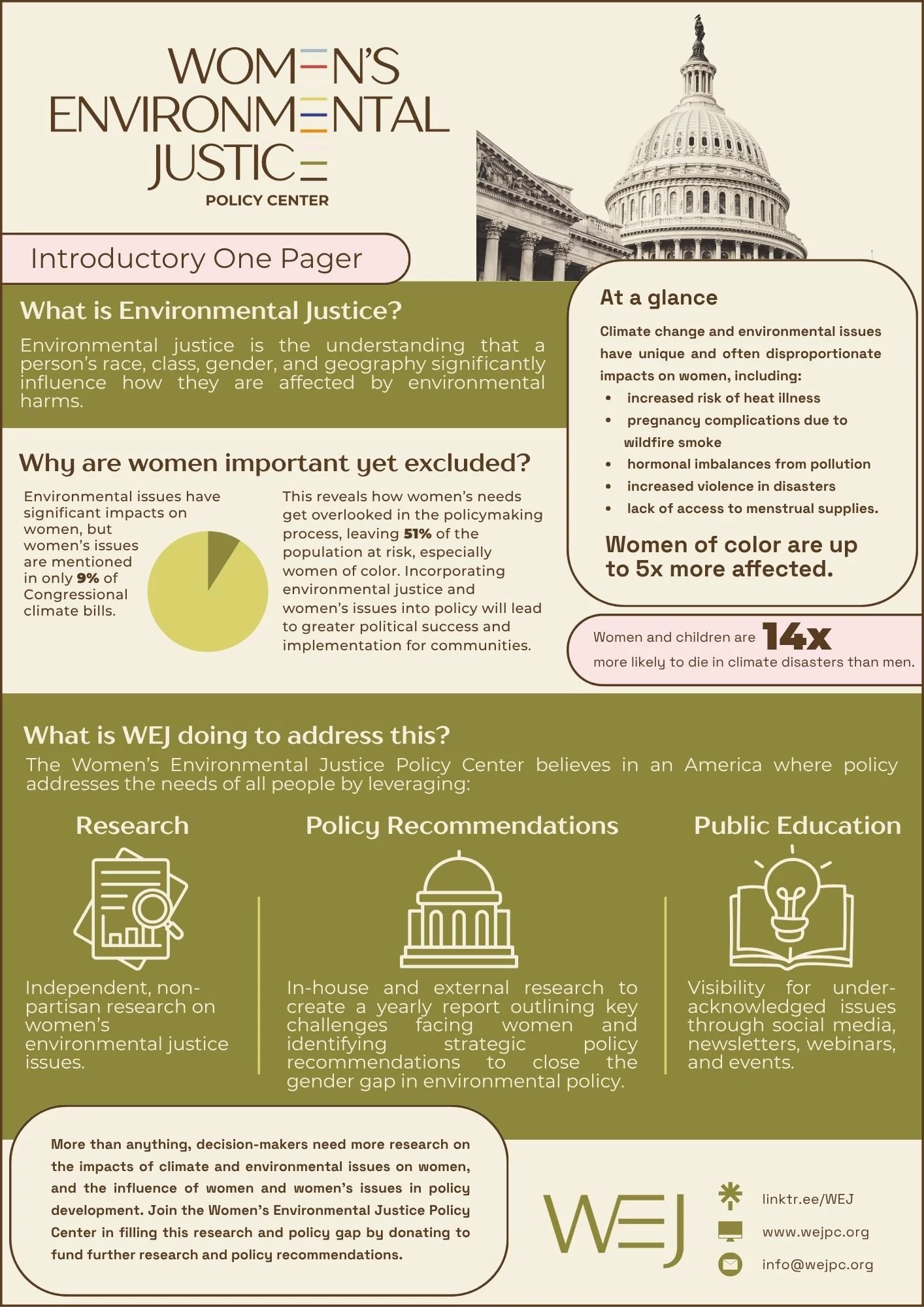
Women’s environmental justice: introductory one-pager
This introductory one-pager outlines key topics and movements that shape women’s environmental justice, explains how climate and environmental harms disproportionately affect women, especially women of color, and outlines the Women’s Environmental Justice Policy Center’s research, policy, and public education response to close this gap.

Women in Congressional climate policy: pilot research report
This pilot research report analyzes how women’s environmental justice concerns are included in U.S. Congressional climate policy during the 118th Congress, revealing that provisions for women appear in only 9% of climate bills, and showing that greater representation by women and BIPOC legislators is associated with stronger, more intersectional attention to gender in climate legislation.